


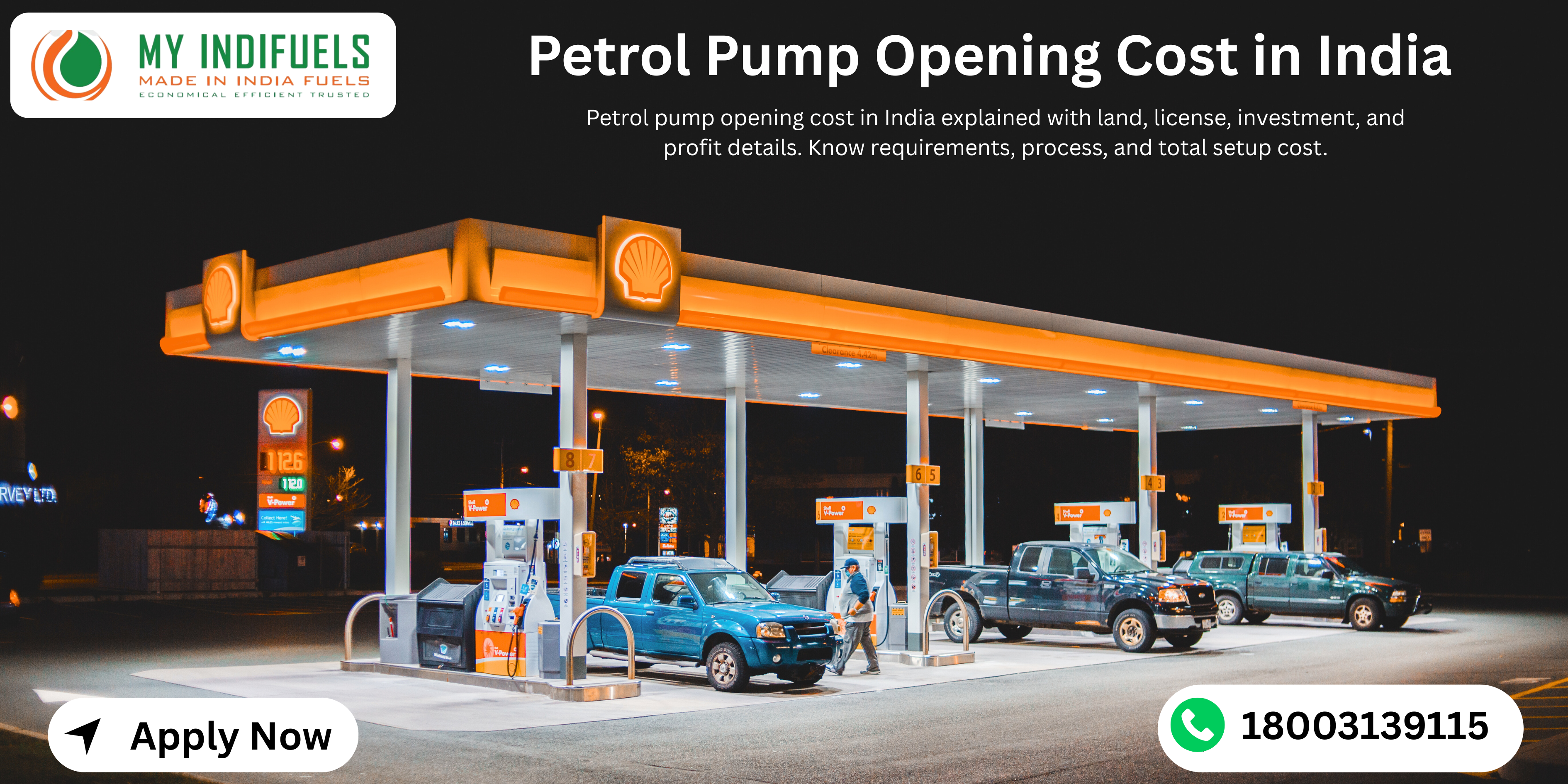
Petrol pumps have been one of the most stable long term business investments in India for decades. While many businesses experience seasonal fluctuations in demand requirements or periods of recession, the demand for petrol and diesel is fairly constant throughout the year. Vehicles require fuel on a daily basis be it two-wheelers, cars, trucks, tractors, industrial machinery or public transport. This stability is the primary reason why a lot of investors, business families, and even new entrepreneurs consider opportunities in fuel retailing. However, the biggest question that comes up at the planning stage is, understanding the Petrol Pump Opening Cost in India, approvals required, how long the process takes and whether the return justifies the investment.
In 2026, the current ecosystem of fuel retail in India is undergoing a rapid transformation.Government-owned companies still dominate, but private oil companies are aggressively expandingtheir networks and alternative energy facilities, such as EV charging, CNG fueling and renewablesolutions, are getting integrated into new fuel stations. This means that the business opportunityis broader than before, but it does require clarity and planning. Companies like My Indifuels helpapplicants by assisting them in dealership procedures, documentation support, eligibility check andbusiness planning so that investors go to the market with clarity instead of confusion.
Understanding How a Petrol Pump Business Works
In order to examine cost, the business model has to be understood. A petrol pump is not a manufacture of fuel but it is a fuel retailer. Petrol, diesel and other fuels are delivered to the pump by oil companies and the owner of the pump receives a commission for each litre sold. The margin per litre is not very high but, the sales volume is high and continuous throughout the year and hence the business is financially stable.
Dealers are not allowed to make the decision of the fuel prices as the control is in the hands of the government or oil marketing companies. Therefore, profitability is not dependent on price control but on sales volume, effectiveness of operations and other revenue streams like convenience stores, air filling, tyre shops, lubricants, and increasingly EV charging units and CNG dispensers. Dealers are not allowed to make the decision of the fuel prices as the control is in the hands of the government or oil marketing companies. Therefore, profitability is not dependent on price control but on sales volume, effectiveness of operations and other revenue streams like convenience stores, air filling, tyre shops, lubricants, and increasingly EV charging units and CNG dispensers.
Understanding the Cost of Opening Petrol Pump in India
The cost of opening a petrol pump in India depends on several major components such as availability of land, type of dealership, infrastructure setup, compliance, licensing and working capital. In 2026, the cost of opening a petrol pump in India generally varies between Rs 60 lakh to 2 crores in case of land availability. If land is required to be purchased, the total cost can go significantly higher, depending on city, state and location category.
To better help first-time entrants understand this, let's break down the major components of investment in simple and structured manner in the following.
Land Requirement and its effect on the Total Cost
Land is the one biggest cost factor of any petrol pump business. Location has both a cost factor and a profitability factor. The land requirement will vary depending on whether the station is in a metro city, town, rural area or along a highway. Typically:
- • Highway stations take much more land areas because the vehicle traffic is higher and so do the infrastructure space requirements.
- • Urban stations may need smaller land areas but the land's price is higher.
- • Rural stations have lower land prices, but often less vehicle density
Applicants have three scenarios for land:
- 1. They already own the land
- 2. They rent land from another individual
- 3. They buy land specifically for the pump business
Purchasing land adds a huge sum of investment, more so in prime commercial locations. The decrease in capital investment with the use of leasing is compensated by the rise in operational expenses every month. Many first-time investors like to use leasing because it reduces entry barriers and provides room for expansion later on when business is stabilized. My Indifuels assists investors in assessing which one performs well to achieve their business goal, anticipated cash flow and risk tolerance.
Dealership Fees and Security Deposits
Once land has been determined to be suitable, the next step is dealership allotment. Oil companies - both the public and private ones - charge an application fee to the person applying for dealership. After selection, a security deposit may also be required. These deposits are different for each company and each category. Public sector units (PSUs) eg IOCL, HPCL and BPCL have lower deposits but high competition due to brand trust and wide consumer recognition. Private companies like Nayara, Reliance and Shell may have greater deposits but often have structured dealership model with modern facilities and quicker negotiation timelines.
Security deposits are usually refundable and are intended to make the applicant comply and to be serious. This part of the cost is often overlooked by first timers, which is why having a structured understanding comes important.
Infrastructure and Construction Costs
Once dealership allotment is secured, the land has to be developed into a functional fuel station. This involves construction of driveways, installation of concrete flooring for easy access in and out, installation of storage tanks, installation of dispensing machines, construction of office cabin, bathrooms, boundary walls and canopy structures. Proper lighting, drainage, electrical wiring, landscaping and firefighting systems must also be installed. This stage depends very much on the rates of construction of civil works in the region, and the final layout agreed by the oil company.
In urban and rural areas where the pumps are smaller, the cost of construction is moderate. On the other hand, in more traffic zones like national highways, extra pumps, tanks, light and bigger entry lanes are needed which increases the total infrastructure cost.
Fuel Dispensing Machines and Fuel Storage Tanks
Dispensing machines and storage tanks comprise the technological heart of a petrol pump. Dispensing machines must meet legal metrology requirements to ensure that fuel is being dispensed accurately to customers. Storage tanks are underground to store the petrol and diesel without any problems. Price of machines is dependent on the number of nozzles and whether or not the automation is integrated. Highway pumps need a greater number of nozzles for handling bulk movement of vehicles whereas pumps located within towns may not require as many.
Automation has become more common as a result of modern audit and compliance demands. Automated systems can be used to monitor fuel levels, sales data, leak detection and cash management more efficiently than manual record keeping.
Licensing & Approvals Compliance Expenses
The licensing process is often the most time consuming part for the new entrants as one needs to get several approvals from different authorities. Regulatory bodies ensure that standards of safety, environmental and operational standards are followed. Some key approvals include:
- 1. Fire safety clearance.
- 2. Petroleum and Explosives Safety Organization (PESO) license.
- 3. Local civic body No Objection Certificate (NOC).
- 4. Environmental compliance approvals.
- 5. Electrostatic and safety compliance checks.
- 6. Weights and Measures certification.
These approvals make sure that fuel stations are operated safely and people have confidence. Many new applicants find this process confusing with the paperwork and inter-department coordination. This is where professional assistance from companies such as My Indifuels helps out by providing guidance to the applicants and avoiding costly delays.
Branding and Marketing Setup
Branding is far more important than most people realize. When customers drive into a fuel station, they rely heavily on visual cues such as signboards, canopy branding, safety signages, and the overall cleanliness of the premises to build trust. Clear, well-maintained branding reassures customers about fuel quality, quantity, and service standards.
Oil companies provide strict branding and design guidelines that dealers must follow to maintain uniformity and brand trust across all retail outlets.
Basic branding includes:
- Canopy boards
- Price display boards
- Authorized logo placements
- Mandatory safety symbols and signages
- Standard guidelines for petrol pump station design
Marketing may also involve local advertising, banners, visibility boards and digital listings. Highway pumps may have increased strength of visibility because of fast moving traffic.
Manpower and Training Costs
Fuel stations need workers to handle pump operations, attend to customers, handle billing, provide security and maintain cleanliness. Number of employees is dependent on pump scale and running hours. Training is important since pump attendants have to follow safety protocols and be accurate while dispensing. Now, oil companies and consultants have training modules for dealers and employees to keep the level of service standard.
Working Capital and Operational Funds
Even after infrastructure is ready, a petrol pump cannot function if it lacks working capital. Dealers have to buy the fuel stock from the oil companies and it requires advance funds to purchase this. The amount of working capital is dependent on estimated daily footfall of vehicles. Highway pumps require more working capital because the turnaround of fuel is faster. Pumps located inside small towns may not need as much.
Without proper working capital, pumps might end up out of stock with no customers as competitors are closer to them, which is especially detrimental during the first year of business.
H3: Total Petrol Pump Opening Cost in India Without Land Purchase
Considering dealerships, construction, compliance, signage, machine installation and working capital costs, Petrol Pump Opening Cost In India, without buying land, generally ranges from Rs. 60 Lacs to Rs. 2 Crores depending on the brand, category of location and overall pump size.
When land purchase is added, the cost can be substantially increased due to the huge difference in the price of land in rural and urban areas in India. Some city outskirts and highways also have a high commercial value because of the logistic advantages.
Public Sector versus Private Sector Dealership Considerations
Public sector companies have a good image in India. Fuel customers have a lot of trust on brands of PSUs because of long presence across markets. However, competition between dealerships is fierce in PSU tenders, and patience may be needed in the process. On the other hand, private companies offer faster negotiations, modern layouts, higher possibility of digital operations and flexible dealership structures. Investors need to pick the brand based upon business capability, location demand and a personal preference.
My Indifuels helps investors compare dealership models in terms of cost, operational flexibility and long-term sustainability.
Return on Investment and Profit Potential
The fuel retail business is a fairly predictable business in terms of return on investment. Returns are not dependent on fuel price fluctuations but rather on sales volume, type of vehicle and additional revenue services. Pumps near industrial areas, large highways or logistics corridors often have breakeven measured in a shorter period of time than pumps in deep inside residential neighborhoods.
On average, the payback for a petrol pump is four to seven years. However, highway pumps having heavy vehicle movement may break even earlier as a result of bulk commercial vehicle fueling.
Important Factors That Affect Profitability
Some factors that have a major impact on profitability include:
- Vehicle footfall and type of traffic
- Local competition and brand preference
- Accessibility and visibility of the land
- Additional services such as lubricant shops, convenience stores, tyre shops, and CNG facilities
- Introduction of EV charging stations and renewable energy modules
Each of these factors contributes significantly to the long-term financial performance of the petrol station.
Future Trends: Multi-Energy Fuel Stations
India's fuel retail segment is no longer confined to petrol and diesel. Government policies and market demand are moving towards cleaner fuel and electric mobility. As a result, new petrol pumps are being designed as "multi-energy stations" that offer petrol, diesel, CNG and EV charging in the same campus. Investors entering the market in 2026 have to think about this transition, in order to avoid disruption in the future. My Indifuels helps investors plan for such multi-energy models and understand long term sustainability.
Role of My Indifuels in the Helping New Investors
New investors have a hard time with documentation, licensing, dealership applications and compliance as the process is not so straightforward for beginners. Mistakes during the early stages can cause delays or rejection that can cost time and money. My Indifuels makes this journey easy by offering support in dealership assistance, land evaluation, compliance coordination, infrastructure planning and marketing positioning so that new petrol pump owners can start their business without any hindrances.
Conclusion
Opening of a petrol pump remains a reliable and future-ready business opportunity in India. The country's transportation demand is increasing and the demand for fuel is backed by both personal mobility and commercial logistics. Understanding Petrol Pump Opening Cost in India helps investors to plan with clarity and not with guesswork. With proper guidance, strategic planning and location, along with financial preparation, petrol pumps can provide stable and long term returns. Companies like My Indifuels help bridge the gap between interest and execution and enables new investors to set up their business with confidence and in compliance with ever evolving energy standards.